
New faith does not grow by accident. The habits a person builds in the first ninety days after deciding to follow Jesus tend to become the habits they keep for years, for better or worse. This article lays out those ninety days as one continuous arc, thirty days at a time, so you can see exactly where you should be standing on day ten, day forty, and day seventy, instead of guessing.
Why the First Ninety Days Set the Pattern for Everything After
Most new believers are handed good advice in pieces. Someone tells them to pray more. Someone else hands them a Bible and says start reading. A third person invites them to church. Each piece is true and useful, but taken in random order, with no sense of sequence, the pieces rarely add up to a habit. A new believer ends up with a stack of good intentions and no clear sense of what to do first, second, or third.
A plan changes that. It tells you what to build in month one so that month two has something to stand on, and what month two builds so that month three has a foundation strong enough to hold a church community and a study group. Think of the ninety days as three thirty-day stretches, each with its own job: showing up, listening, and belonging.
Days 1 to 30: Learning to Show Up
The first thirty days are not about depth. They are about consistency. The single goal of this month is to show up at the same time, in the same way, often enough that it stops feeling like an event and starts feeling like a rhythm.
Two things belong in this window: prayer and the Gospels. Start with prayer, because prayer is the simplest habit to build and the easiest one to feel progress in. A short, honest conversation with God each morning or evening, even five minutes, teaches your body and your calendar that this time belongs to Him. If you want a day by day structure for this exact stretch, a steady prayer habit built over thirty days walks through it.

Alongside prayer, start reading the Gospels. Not the whole Bible, not yet. Just Matthew, Mark, Luke, and John, read slowly enough that you’re meeting Jesus rather than skimming facts about Him. The goal in these thirty days is familiarity with His voice, His questions, His way of dealing with people. A guide to reading the Gospels as a new disciple will help you read them in a way that sticks rather than just passes through you.
By day 10, you should have a prayer time that happens most days without reminder and a few chapters of Matthew behind you. By day 30, prayer should feel like a fixture in your day and you should have moved through at least one full Gospel. That’s the whole job of this month: build the habit of showing up before you try to build anything more complicated on top of it.
Days 31 to 60: Learning to Listen
Once prayer and reading are steady, the second month shifts from showing up to listening. This is where meditation and the Holy Spirit’s guidance enter the picture, and it’s also where most new believers get stuck if they try to start here instead of after the first thirty days.
Biblical meditation is different from simply reading quickly and moving on. It means taking a verse or a short passage and sitting with it, turning it over, letting it fill your mind rather than emptying your mind the way other meditation practices teach. The difference matters, and a closer look at biblical meditation compared to mindfulness explains why filling your mind with truth works differently than clearing it out.

At the same time, this is the season to start paying attention to how the Holy Spirit speaks into ordinary decisions. Not dramatic moments, but the small nudges: a conviction about a conversation, a sense of peace or unease about a choice, a verse that suddenly applies to your week. Learning to recognize that voice takes practice, and a daily guide to recognizing the Holy Spirit’s guidance gives you a way to start noticing it on purpose rather than by accident.
By day 40, you should be able to sit with a single verse for several minutes without your mind wandering off within thirty seconds. By day 60, you should be able to point to at least one or two decisions in your week where you can say, with some confidence, that the Spirit nudged you one way rather than another. That is the whole aim of this month: move from reading words to hearing a voice.
Days 61 to 90: Learning to Belong
The last thirty days turn outward. Prayer and meditation build something inside you, but faith was never meant to stay private. The final stretch is about finding a church home and learning to study Scripture with other people instead of alone.
Finding a church is not the same as attending a service. It means finding a body of believers where you can be known, where someone would notice if you stopped showing up. A guide to finding a local church you can call home walks through what to look for beyond the quality of the sermon or the style of the music.
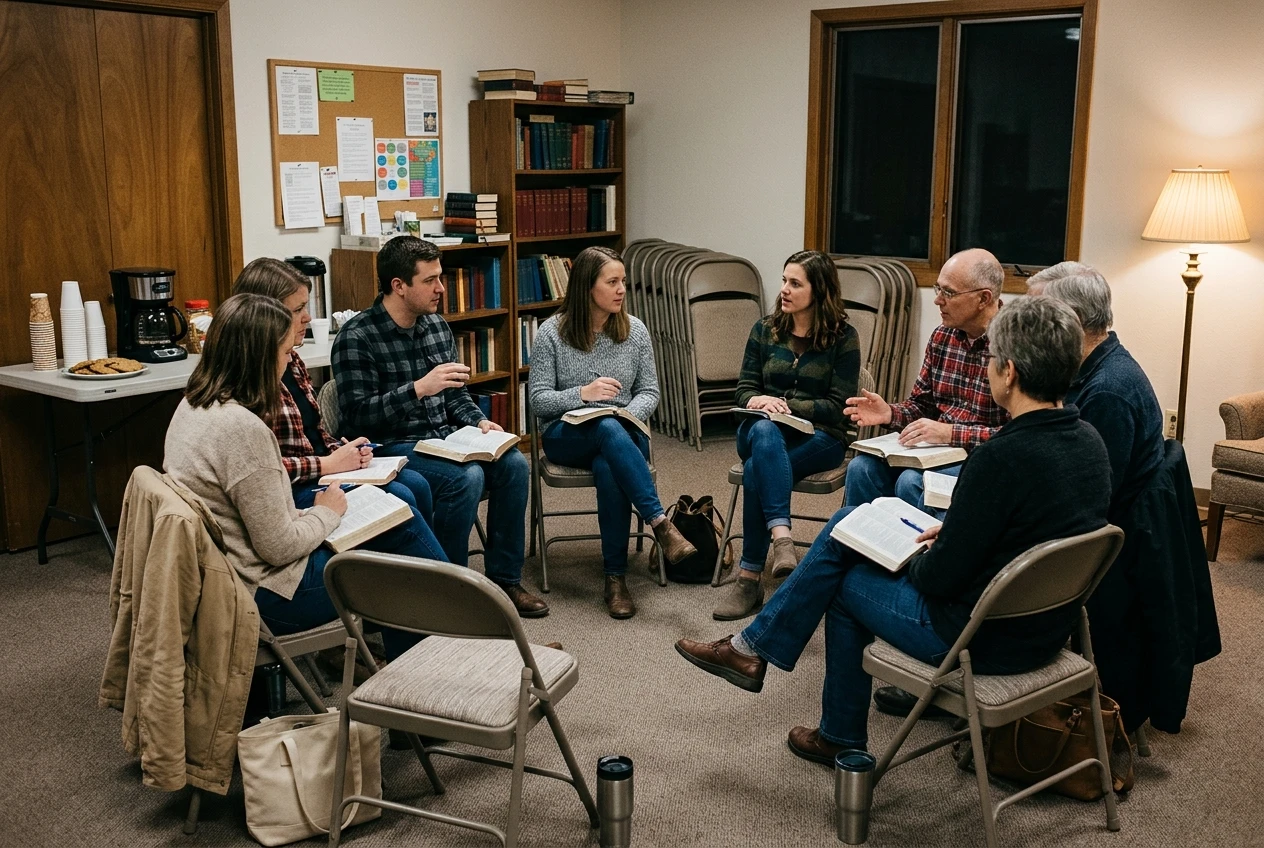
Community study matters just as much. Jesus did not train one disciple in isolation. He trained twelve, together, in the same room, hearing the same teaching and wrestling with the same questions. The case for studying Scripture in community lays out why that pattern still matters for a new believer today, and why reading alone, however faithfully, leaves something out that only other people can supply.
By day 70, you should have visited several churches and started narrowing toward one. By day 90, you should be attending somewhere regularly and have at least one small group, Bible study, or community of believers you’re studying alongside. That’s the job of this final month: move from a private faith to a shared one.
Signs You’re Actually Growing, Not Just Busy
It’s easy to confuse activity with growth. You can check every box on this plan, pray daily, read every morning, attend church every Sunday, and still not be changing much underneath. A few honest markers help you tell the difference.
-
You notice your reactions changing before your circumstances do. Patience, honesty, and generosity start showing up in small moments without you forcing them.
-
Scripture starts coming to mind unprompted, in the middle of a conversation or a decision, rather than only when you’re sitting down to read it.
-
You want other believers around you, not out of obligation but because their company has become genuinely helpful.
-
Confession and correction stop feeling like failure and start feeling like something you can walk through without shame.
None of these show up on a calendar. They show up in ordinary weeks, which is exactly why the thirty-day structure matters: it gives growth time and repetition to actually take root rather than asking it to appear overnight.
What Happens When Life Interrupts the Plan
No ninety days goes untouched by a sick child, a demanding season at work, a move, a crisis. The plan above assumes a fairly ordinary stretch of life, and ordinary life rarely cooperates for three full months in a row.

When that happens, the instinct is to treat the interruption as failure and start over from day one, or worse, to quietly give up on the whole thing. Neither is necessary. What matters more than hitting every single day on schedule is returning to the rhythm as soon as you can, rather than letting one missed week turn into a missed month. A guide to staying consistent when your schedule falls apart covers exactly this problem and gives you a way to hold the plan loosely enough to survive real life without losing the shape of it altogether.
Why Walking This Timeline Alone Is Harder Than It Looks
Reading this plan is one thing. Living it for ninety consecutive days, remembering which habit belongs to which month, catching yourself when you drift back to reading Scripture the same old way instead of meditating on it, noticing when you’ve quietly stopped listening for the Spirit because life got loud again, that takes more than a single article can give you. It takes a structure that checks in with you week by week and tells you what comes next before you have to ask.
That is exactly what a guided course is built to do. Instead of holding all three stretches in your head at once, each week’s focus is laid out for you in order, so the sequence this article describes becomes something you actually walk through rather than something you read and intend to follow.
Start your guided ninety day journey inside the course, where each week’s Focus is already mapped out for you so you never have to guess what comes next.