
Most of what you have heard about meditation probably came from a yoga class, a wellness app, or a friend who swears by sitting quietly for ten minutes each morning. The instruction is almost always the same: empty your mind. Let the thoughts pass like clouds. Find the blank space underneath the noise.
If you have tried that and found it does not stick, you are not failing at meditation. You are discovering that an empty mind does not stay empty for long. Something always moves back in: the email you need to send, the argument from last week, the worry about money or health that was waiting at the edge the whole time. Biblical meditation starts from a different premise entirely, and once you see the difference, the whole practice makes more sense.
Why “Just Clear Your Mind” Never Quite Worked
Clearing your mind asks you to hold a vacuum, and a vacuum does not hold. The brain is built to think about something. Tell it to think about nothing and it will scan for the nearest thing to grab onto, usually the thing you were most trying to avoid.
This is why so many people try mindfulness apps for a week or two and then drift away. The stillness feels good in the moment, but it rarely changes anything by Tuesday afternoon when the same anxious thought shows up again. The practice managed the thought for five minutes. It did not replace it with anything.
Scripture never asks you to empty your mind. It asks you to fill it, deliberately, with something strong enough to stay there.
What Mindfulness Gets Right, and Where It Stops Short
Mindfulness deserves some credit. It correctly notices that most people live reactively, pulled along by whatever thought is loudest, and that slowing down to notice your own mind is a real skill worth building. The attention it trains, the pause before reacting, the awareness of your own breathing and body: these are not nothing.
Where it stops short is the object of attention. Mindfulness, in its popular form, treats the present moment itself as the goal. Notice your breath. Notice the sounds in the room. Notice the thought, then let it go. The practice trains you to observe, but it does not tell you what is true, what is good, or what you should believe about the thought you just noticed.
Biblical meditation uses the same kind of focused attention mindfulness trains, but it points that attention at something specific: the word of God. The skill of slowing down and paying close attention is useful. What you pay attention to is what actually changes you.
The Biblical Difference: Meditation as Filling, Not Emptying
The Hebrew word behind “meditate” in most of the Old Testament, hagah, carries the sense of muttering, murmuring, turning something over out loud or in your mind, the way you might turn over a problem you cannot stop thinking about. It is the opposite of blankness. It is active, repetitive engagement with specific words.

Biblical meditation takes a verse, a phrase, a truth from scripture, and turns it over and over until it stops being words on a page and starts being the lens you think through. You are not trying to empty your mind of the day’s worries. You are trying to fill it so full of God’s word that the worries have to find room around it instead of the other way around.
This is a meaningful shift for anyone early in following Jesus. You are not learning a technique for calm. You are learning a way of thinking that reshapes what you believe is true about your circumstances, your fears, and your future.
What Joshua 1:8 and Psalm 1 Actually Mean by Meditate
Joshua 1:8 tells Joshua not to let the Book of the Law depart from his mouth, but to meditate on it day and night, so that he may be careful to do everything written in it. The order matters: meditation comes before obedience. You cannot carefully do what you have not first turned over in your mind long enough to understand and remember.

Psalm 1 describes the person who delights in the law of the Lord and meditates on it day and night as being like a tree planted by streams of water, bearing fruit, with leaves that do not wither. The meditation is not the fruit. It is the root system underneath it, invisible, constant, drawing up what the tree needs to produce something real.
Both passages treat meditation as ongoing rather than occasional. Day and night does not mean every waking hour is spent in formal reflection. It means the verse stays available, returning to mind during the drive to work, the dishes, the sleepless hour at 2 a.m., because it was placed there deliberately and given time to settle.
Choosing One Verse and Dwelling in It, Step by Step
You do not need a long passage to begin. One verse, held well, does more than a chapter skimmed quickly.
-
Pick a short verse that speaks to where you are right now. Something steadying, like Psalm 23:1 or Philippians 4:6-7, works well for a first attempt.
-
Read it slowly, several times, out loud if you can. Notice which word your attention lands on first.
-
Ask simple questions of it. What does this say about God? What does it say about me? What would it look like to actually believe this today?
-
Say it back to God in your own words. Meditation moves naturally into prayer when you let it.
-
Carry one phrase with you through the day. You do not need to remember the whole verse perfectly. One phrase, repeated quietly, keeps doing its work hours later.
If you want a fuller method for working through a passage like this, a simple method for moving past just reading walks through it in more depth.

Building a Five Minute Habit You Can Keep
Five minutes, done consistently, will shape your thinking more than an hour attempted once and abandoned. The habit matters more than the length.
Pick a time that already exists in your day rather than inventing a new one: right after you wake, during a coffee break, before you turn off the light. Keep the same verse for several days in a row instead of switching daily. Repetition is what allows a verse to move from something you read to something you think with.
If mornings tend to disappear before you get to anything, a short prayer habit built around the same kind of daily consistency can help both practices reinforce each other. A steady prayer habit built over thirty days is worth looking at if you want a simple structure to hang this on.
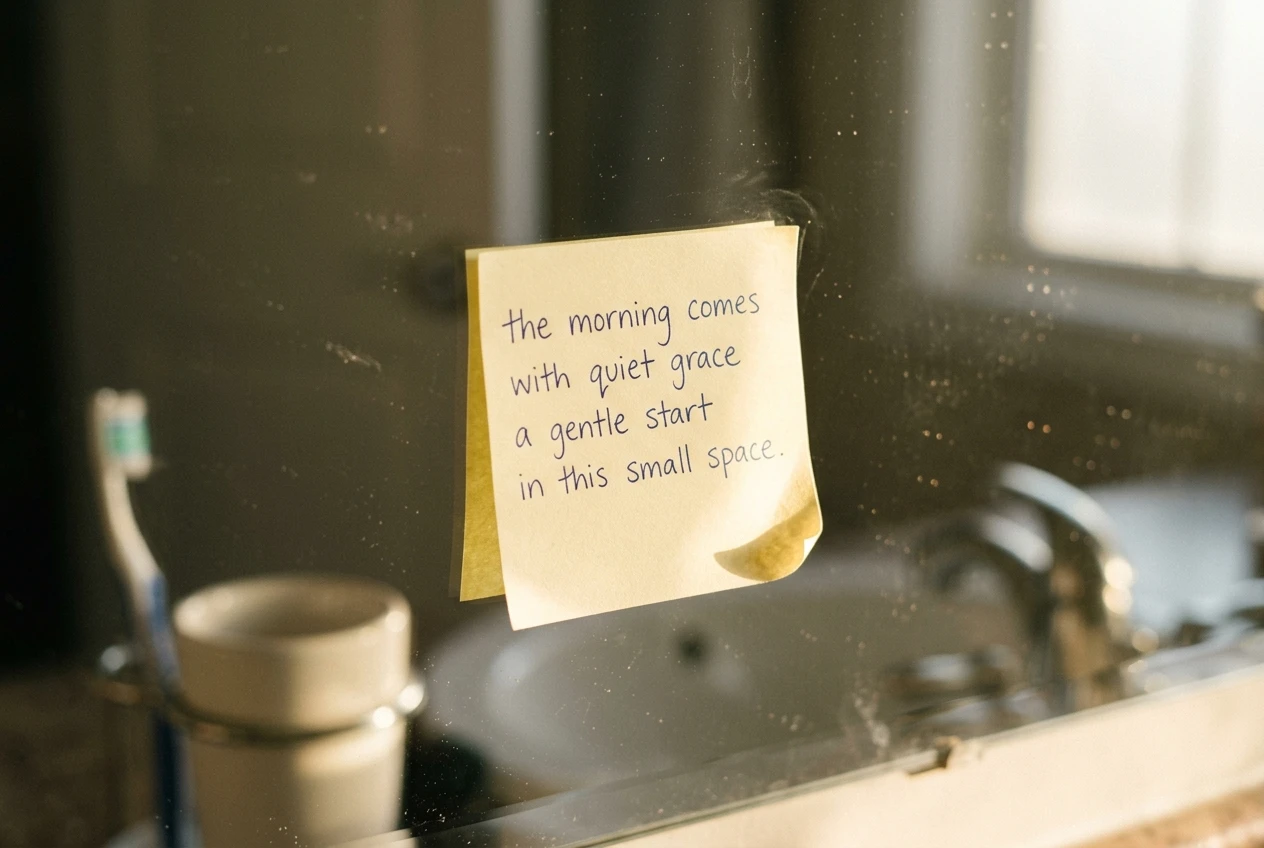
Write the verse somewhere you will see it again: a sticky note on the mirror, a card in your wallet, a note on your phone’s lock screen. The goal is not a perfect quiet time. The goal is a verse that keeps surfacing on its own.
When Your Mind Drifts Back to Worry Mid Meditation
It will happen. You will sit down to meditate on a verse about peace and find yourself three minutes later reviewing an argument from last week instead. This is not a sign you are doing it wrong. It is a sign you are human, and it happens to people who have meditated this way for decades.
When you notice the drift, do not fight it or get frustrated with yourself. Simply return to the verse. Say it again. Let the worry sit next to the verse rather than trying to force it out, and often you will find the worry starts to look smaller next to the truth you just placed beside it.
This is actually where biblical meditation does something mindfulness cannot. A technique for noticing your thoughts does not tell you what to do with a worry once you have noticed it. A verse held in your mind gives the worry something to answer to. Philippians 4:6-7 does not just observe anxiety. It answers it, with prayer, thanksgiving, and a peace it names specifically. That is the difference between managing a thought and replacing it with something stronger.
If this way of meditating on scripture helped, your subscription gives you the full daily plan and guided practices to keep building the habit week by week.