
Jesus could have taught one person at a time. He had three years of ministry and the authority to call anyone he wanted. Instead, he gathered twelve men, lived with them, ate with them, and sent them out two by two rather than one by one. That choice tells you something about how he meant for his teaching to be carried forward, and it matters for how you study scripture today.
Why Jesus Trained Twelve, Not One
The twelve disciples argued with each other, misunderstood Jesus’s parables, and competed for status along the road. Jesus didn’t remove them from that friction. He let them work it out in front of him and with him. When he sent them out in Luke 10, he sent them in pairs, not alone. When he promised that he would be present “where two or three are gathered” in his name, he was describing a minimum, not a preference.
This pattern continues after the resurrection. Jesus doesn’t commission the disciples individually to go start separate, private ministries. He gives them a shared commission in Matthew 28, and the outcome is a church, not a collection of independent teachers. If the Son of God, teaching with perfect clarity, still chose to disciple people in a group rather than one by one, that is worth paying attention to before assuming your own study can do everything alone.
What Happens in Your Mind When You Study Alone
Solo Bible study is not a mistake. It is where understanding starts. You read a passage, you slow down, you ask what it means and how it applies to you, and that work is necessary. If you have not yet built that habit, a method like the one in how to do a deep bible study for beginners is the right place to begin.

But a mind working alone on scripture has a blind spot it cannot see past on its own. You bring your own assumptions to the text, and nothing in a solitary reading session forces you to notice them. You might read a passage about forgiveness and quietly skip over the parts that convict you, because there is no one in the room to ask why you skipped them. You might land on an interpretation that feels true simply because it is familiar, not because it matches what the passage says.
This is not a character flaw. It is how one mind works without another mind checking it. A person reading alone can mistake a feeling of confidence for actual understanding, and the two are not the same thing. The feeling of “I get this now” can show up whether you have understood the passage correctly or missed it badly, and alone, you have no way to tell which one happened.
The Early Church Didn’t Study in Isolation
Acts 2:42 describes the first Christians devoting themselves to the apostles’ teaching, to fellowship, to the breaking of bread, and to prayer, all in the same sentence. Those four things are not listed as separate options a believer could choose between. They happened together, in the same gatherings, among the same people.
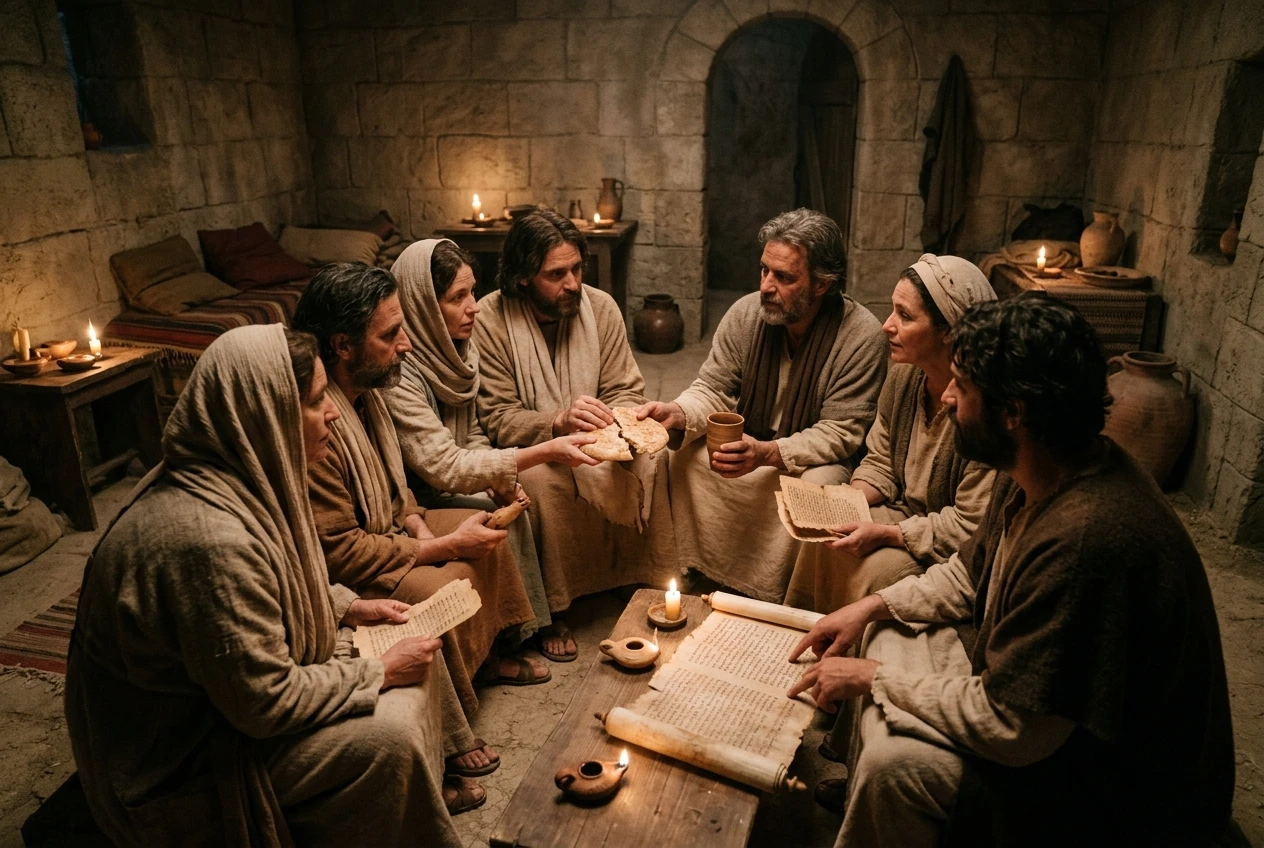
The New Testament letters themselves are evidence of this. Paul did not write private journals for individual reflection. He wrote letters meant to be read aloud to entire congregations, discussed, and lived out together. When he corrects a church in Corinth or encourages one in Philippi, he is writing to a body of people who were expected to wrestle with his words in each other’s presence, not in isolation.
Even the phrase “one another,” which appears dozens of times across the New Testament, assumes more than one person is present. You cannot love one another, bear one another’s burdens, or spur one another on toward love and good deeds by yourself. These are instructions that only make sense inside a group, and they describe what the early church understood discipleship to require.
How Community Turns Head Knowledge into Heart Guidance
There is a difference between knowing what a passage says and having it shape how you actually live. That gap closes faster in community than it does alone, for a simple reason: other people remember things you forget, and they say things out loud that you only thought.
When you study a passage by yourself and move on, the insight often fades within days. When you discuss that same passage with others, you hear it again through their questions, their disagreements, and their own experiences applying it. That repetition, from more than one angle, is part of how the Holy Spirit works a truth from your head into your habits. Jesus promised the Spirit would bring his teaching back to memory, and that promise tends to be fulfilled through the very ordinary means of someone else asking, “Didn’t we just read about this last week, when you were struggling with the same thing?”
Accountability works the same way. A private conviction is easy to set aside once the reading session ends. A conviction you have spoken out loud to someone else, who will ask you about it next week, is much harder to quietly abandon. This is not about performing for other people. It is about letting people who know what you are trying to live out help you actually live it out.
Signs You Might Be Stuck in Isolated Study
A few patterns suggest your study has stayed solitary longer than it should have:
-
You can explain a passage clearly but cannot point to anything in your life that has changed because of it.
-
You read scripture regularly but have no one who knows what you are currently studying or struggling with.
-
You find yourself avoiding certain topics or questions because there is no one to push back when your interpretation gets convenient.
-
You have grown comfortable with uncertainty on a question scripture actually addresses clearly, simply because you have never had to defend your view to someone else.
-
Weeks or months pass without anyone asking how your walk with Jesus is actually going, beyond a passing greeting.
None of these mean your private study has failed. They mean it has reached the point where it needs a second voice, or a third, to keep doing what it is meant to do.
Finding or Building Your Study Community
You do not need a formal theology background or a perfect group to start. You need other people who are also trying to understand and live out what scripture says, and a regular time to talk about it together.

A local church is the most direct route, if you have one you can attend. Many churches run small groups or Bible studies specifically built around discussion rather than lecture, and visiting one as a guest costs you nothing but an hour. If you are new to a congregation, ask whoever greets you at the door whether a group like that exists. Most churches have one, even if it is not advertised well.
If attending in person is not possible right now, an online community built around shared scripture study, like the discussion space connected to this course, can serve the same purpose. What matters is not the format but whether real conversation happens: people asking each other questions, disagreeing respectfully, and following up on what someone said they were working through.
If no group exists yet where you are, you can start one with two or three other people. Jesus didn’t wait for a crowd. He started with twelve.
Bringing Your Personal Study Into the Group
Your solo study and your group study are not competing activities. The private reading you already do, working slowly through a passage, asking what it means and how it applies, is exactly what feeds a good group discussion. Without it, group time tends to drift into opinion-sharing with no foundation. With it, you arrive with something real to bring.
Write down the questions your personal study raises, even the ones you cannot answer. Those are often the most valuable thing you bring to a group, because someone else has likely wrestled with the same question and found something you missed. Bring the verse that convicted you, not just the one you understood easily. Say out loud what you are struggling to apply, not only what you have figured out.
This is the step that turns private understanding into lived guidance: taking what you have worked through on your own and placing it in front of other people who will ask you about it again.
If you have been studying scripture faithfully on your own, that work has not been wasted. It has prepared you for this next step. Bring what you are learning into a group, whether that is the discussion community inside this course or a Bible study at a church near you, and let other people help what you know take root in how you actually live.