
You have a phone full of app store results, a browser tab of Bible websites, and a nagging question: do you actually need to pay for any of this? It is a fair question, and it deserves a fair answer rather than a sales pitch in either direction. Free tools do real work. So does a paid, guided study. The trick is knowing which one matches where you are right now.
What Free Bible Study Tools Actually Offer
Free Bible apps and websites give you more than most new believers realize. You can read almost any translation, compare several side by side, search a word across the entire Bible, and set a daily reading plan that sends you a reminder. Many of these apps also include short devotionals, basic cross-references, and audio Bible options for listening during a commute or a walk.
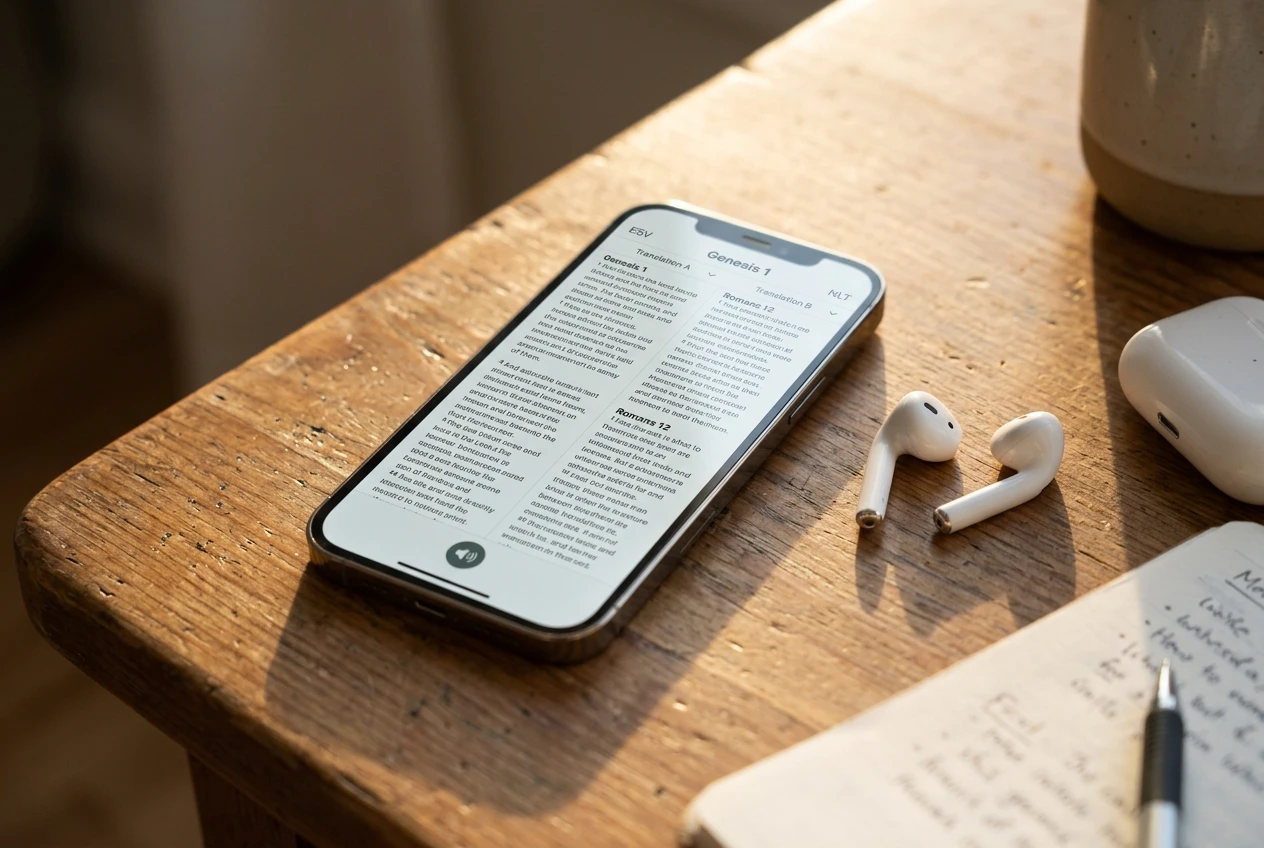
For getting words in front of your eyes and building a daily habit, free tools are genuinely enough. If your goal this month is simply to open the Bible every day and read a chapter, a free app will carry that weight without any trouble. The habit itself matters more than the tool that holds it, and you do not need to spend money to start reading consistently.
Free tools are also a fine place to try different translations and see which one reads most naturally to you. If you have not settled on a study Bible yet, working through a few free options first can help you figure out what you prefer before you commit to anything, paid or printed. Choosing a Study Bible walks through how to think about that choice if you want more on that specific decision.
Where Free Tools Tend to Fall Short for a New Believer
The gap shows up once you move from reading to understanding. A free app can show you that a word appears forty times in the New Testament. It cannot tell you why that matters for how you live this week, or how that word connects to three other ideas Jesus was building across the Gospels.
Most free plans are built around volume: read the Bible in a year, read a chapter a day, read through a book in thirty days. They move you forward, but they rarely explain. You finish a reading and you are not sure what you were supposed to take from it. For someone new to following Jesus, that gap is where discouragement creeps in. You start to wonder if you are missing something everyone else already understands.

Free tools also tend to be generic. The same plan is handed to a brand new believer and someone who has read the Bible for twenty years. There is no sense of sequence, no sense that today’s reading is building toward next week’s, and no one asking whether you actually understood what you just read. A commentary note or a devotional thought can tell you what a passage says. It is a different thing entirely to be taught how to study it yourself, in a way you can return to on your own later.
What a Guided, Paid Study Adds That Free Tools Usually Can’t
A paid, guided study is built around a different goal: not just getting you through the text, but training you in how to think about it. That usually means a deliberate order, where one lesson sets up the next, rather than a list of chapters with no connective thread between them.
It also tends to include teaching, not just text. Someone has already done the work of explaining the context, the original setting, and the connections between passages, so you are not left guessing at what a verse meant to the people who first heard it. That teaching is often designed to come back to memory later, so that when a real situation in your life calls for guidance, you are not starting from zero. You are drawing on something you were actually taught, not just something you once read.

Community is frequently part of the package too, whether that is a discussion group, a cohort moving through the material together, or simply a structure that assumes you are not doing this alone. Why Jesus Trained Twelve, Not One makes the case for why that matters more than it might seem at first. Jesus did not disciple in isolation, and a guided study that includes other people is working with that same pattern rather than against it.
None of this means free tools are inferior as tools. It means a paid, guided study is solving a different problem: not “how do I read the Bible” but “how do I grow from it in a way I can actually hold onto.”
A Simple Way to Decide What You Need Right Now
Ask yourself three questions honestly.
Can I explain what I read yesterday? If you can summarize the passage and say something specific about what it meant, your current tools are working. If you are drawing a blank, that is a sign you need more structure or teaching, not just more reading.
Am I reading consistently, or am I still trying to build the habit? If consistency itself is the struggle, a free reading plan with reminders is the right next step. Adding a paid study on top of an unformed habit usually just adds pressure, not progress.
Do I want to understand on my own, or do I want someone walking with me through it? Both are legitimate. Free tools lean toward self-directed exploration. A guided study leans toward being taught, step by step, with someone else setting the pace and filling in what you would not know to look for on your own.
There is no wrong answer here, only an honest one. Where you land depends on what season you are in, not on which option sounds more serious or more spiritual.
Mixing Free and Paid: A Realistic Starting Point
You do not have to choose one and abandon the other. A lot of new believers do their best work using free tools for daily reading and a paid, guided study for depth. The free app keeps the Bible open in front of you every day. The guided study gives you a place where that daily reading gets explained, organized, and connected to something bigger than a single chapter.

If you are building your daily rhythm right now, pairing a simple reading plan with a prayer habit is a good place to start. How New Believers Can Build a Steady Prayer Habit in Thirty Days lays out one way to do that without needing to spend anything. Once that rhythm feels steady, a guided study can take what you are already reading and give it the structure that turns reading into understanding.
Questions Worth Asking Before You Subscribe to Anything
Before you commit money to a study, it is worth slowing down and asking a few questions rather than signing up on impulse or avoiding it out of hesitation.
-
Does this study explain the “why” behind the text, or just move me through more of it?
-
Is there a clear order to the lessons, or is it a loose collection of topics?
-
Will what I learn come back to mind later, when I actually need it, or is it only useful while I am reading it?
-
Am I paying for teaching and structure, or just for a nicer version of something free tools already do?
-
Can I try it for a short period before committing to it long term?
These questions apply to any paid study, not just one specific option. Answering them honestly will tell you far more than a glossy landing page will.
If you work through those questions and decide that guided structure is genuinely what has been missing from your reading, it is worth seeing what that actually looks like in practice: Why a Structured Discipleship Course Gets You to Spiritual Maturity Faster. And if the bigger question is whether investing time and money in your walk with Jesus is worth it at all, Counting the Cost is the place to weigh that honestly before you decide.